
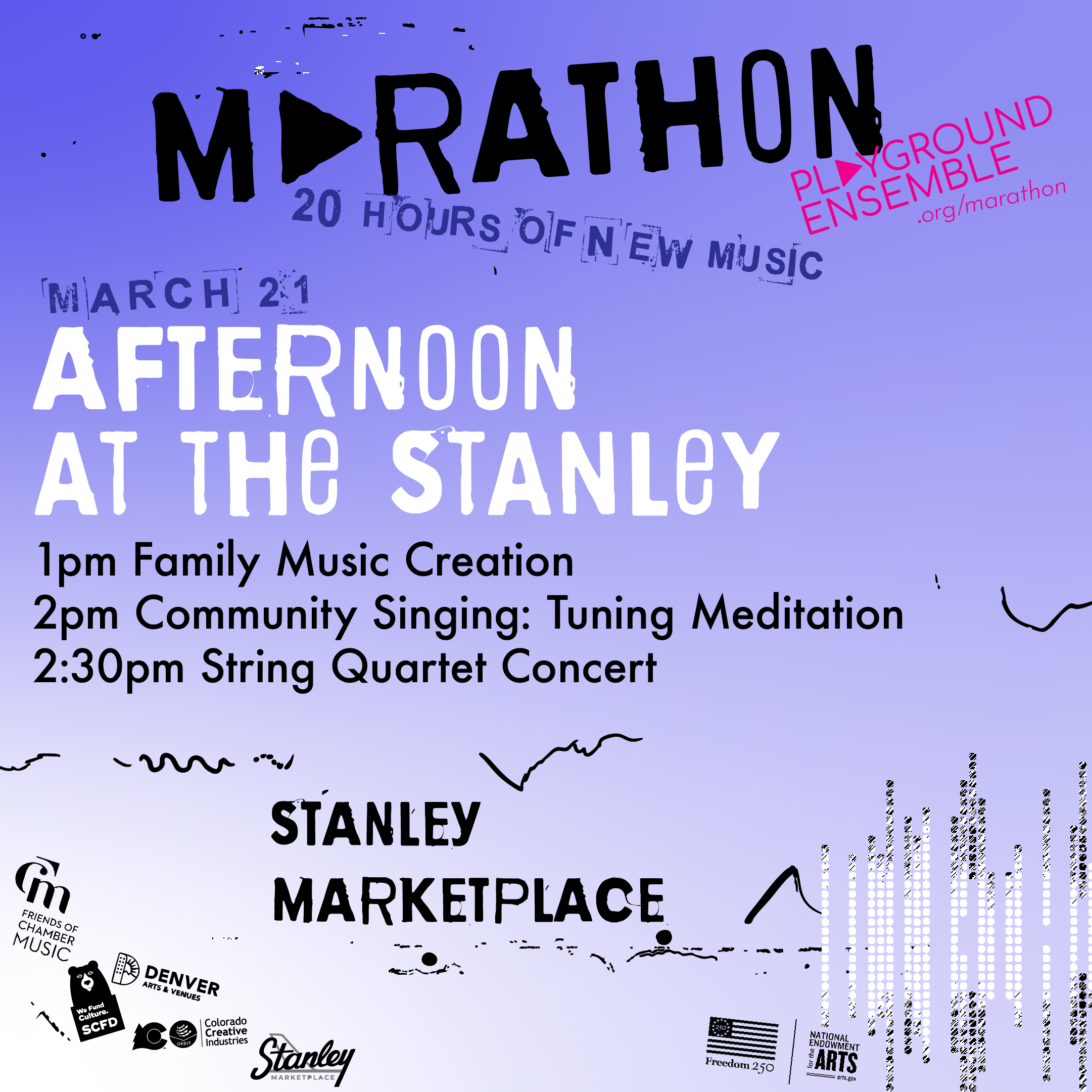
In celebration of our 20th season, The Playground is planning a 20-hour MARATHON! This event will be broken into four blocks, each at a different venue in Denver. MARATHON will be structured to highlight all that we do as an ensemble and organization: concerts, community music-making, sessions for music educators, healing arts events, and an improvised communal cool down in the early hours of Sunday morning.
Like what you see/hear? Consider donating to support our programming for our 20th anniversary!
String Quartet Concert
Saturday March 21, 2026, 2:30 pm
Stanley Marketplace
2501 Dallas St, Aurora, CO 80010
Unit 46 on the second floor
Free to attend
The Playground Ensemble partners with Friends of Chamber Music to bring an afternoon of music creation and community to The Stanley Marketplace. In keeping with the spirit of the Stanley, the Playground String Quartet provides an eclectic sample of works by Latino, Indigenous, and women composers. Including works by Gabriela Ortiz, Raven Chacon, and Caroline Shaw, this program contains the breadth of both Playground's style and their mission.
Sarah Whitnah, Violin
Robyn Julyan, Violin
Catherine Beeson, Viola
David Short, Cello
Program
Altar de Muertos by Gabriela Ortiz
I. Ofrenda
The tradition of the Day of the Dead festivities in Mexico is the source of inspiration for the creation of a work for string quartet whose ideas could reflect the internal search between the real and the magic, a duality always present in Mexican culture, from the past to this present.
Altar de Muertos is divided into four parts, each of these describe diverse moods, traditions and the spiritual worlds which shape to the global concept of death in Mexico, plus my own personal concept of death. First part: "Ofrenda." This music describes the visit of four spirits to the altar, each one singing his/her own ofrenda (offering) towards the end of this movement, the four spirits converge in a single chant to as the end of a funeral procession.
Metro Chabacano by Javier Álvarez
“The seminal idea for Metro Chabacano came from an earlier piece for string orchestra, Canción de Tierra y Esperanza, which I had presented to my parents as a Christmas gift in 1986… In 1990, the sculptor Marcos Limenez approached me with the idea to use Canción to accompany one of his astonishing kinetic installations, which was to be on display in one of Mexico City’s busiest subway stations for a period of three months. This provided the perfect motivation for me to revise the piece and for the Cuarteto Latinoamericano to do the first performance, which took place in 1991 at the Metro Chabacano subway station as part of the dedication ceremonies…
Metro Chabacano has a continuous eighth-note movement of moderately driving speed from which short melodic solos emerge from each instrument. The repeated notes give a false sense of simplicity; although the piece is brief and in a single movement, the rhythms, accents and melodic fragments that emerge from the perpetual motion background are intricately playful.”
Homenaje a Gismonti by Arturo Márquez
Arturo Marquez's Homenaje a Gismonti pays tribute to the music of Brazilian guitarist Egberto Gismonti. The piece is built over an extended vamp on alternating chords, starting with a guitar-like pizzicato. This is interspersed with passages in which minimalist repeated patterns or held chords form a background for free-flowing melody. Increasingly complex cross-rhythms and diminutions build towards the end of the piece, culminating in a final unison flourish.
The Journey of the Horizontal People by Raven Chacon
The Journey of the Horizontal People is a future creation story telling of a group of people traveling from west to east, across the written page, contrary to the movement of the sun, but involuntarily and unconsciously allegiant to the trappings of time. With their bows, these wanderers sought out others like them, knowing that they could survive by finding these other clans who resided in the east, others who shared their linear cosmologies. It is told that throughout the journey, in their own passage of time, this group became the very people they were seeking.