
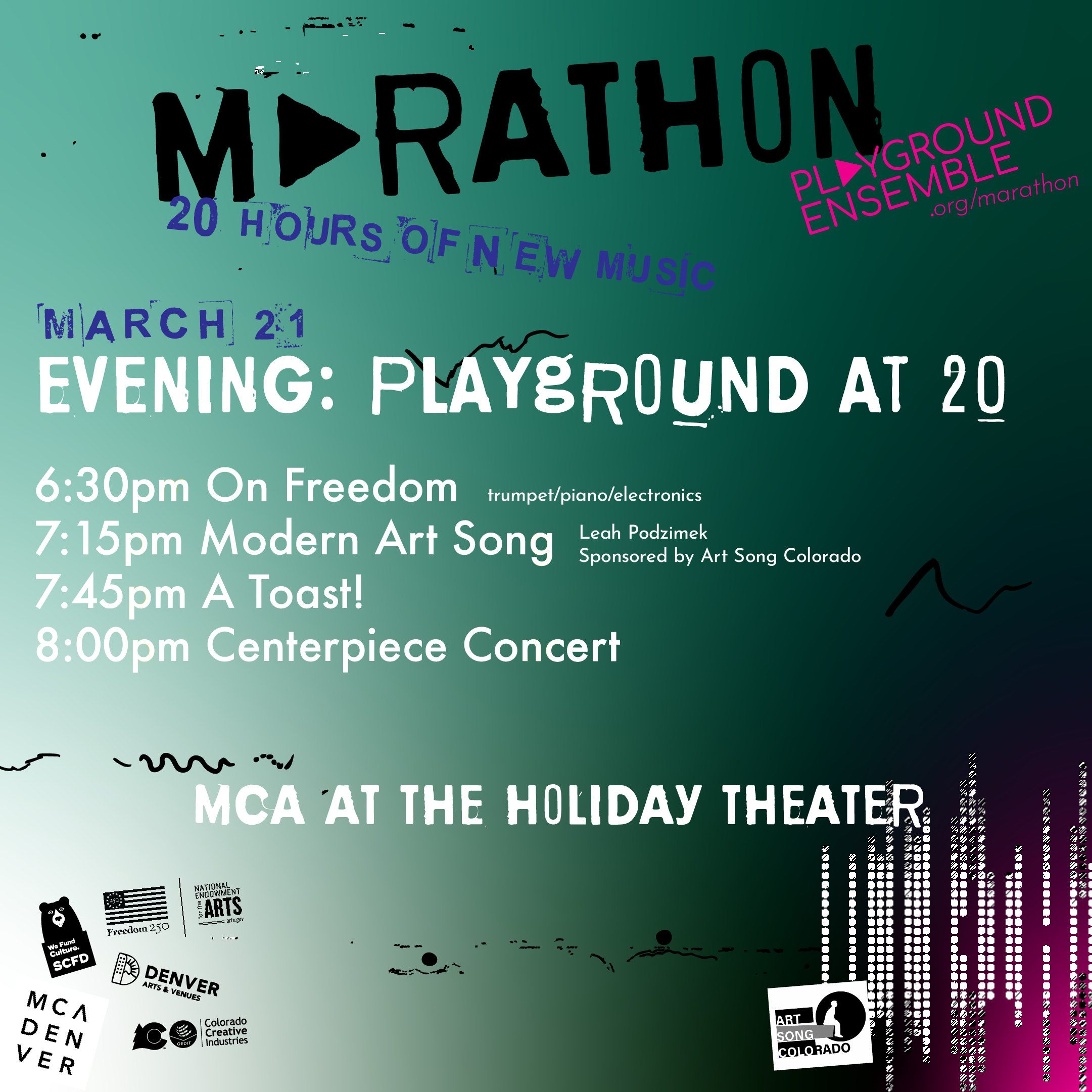
In celebration of our 20th season, The Playground is planning a 20-hour MARATHON! This event will be broken into four blocks, each at a different venue in Denver. MARATHON will be structured to highlight all that we do as an ensemble and organization: concerts, community music-making, sessions for music educators, healing arts events, and an improvised communal cool down in the early hours of Sunday morning.
Like what you see/hear? Consider donating to support our programming for our 20th anniversary!
Playground at 20! Concert
Saturday March 21, 2026, 8:00 pm
MCA Denver at the Holiday Theater
2644 W 32nd Ave, Denver, CO 80211
$20 Tickets
Hosted by MCA Denver at the Holiday Theater, this evening series of concerts is the heart of MARATHON. At 8:00 pm is our main event, the Playground @ 20! concert! This chamber concert features the first work we ever played, a new commission by Carlos Sanchez-Gutierrez for bass flute and ‘ghost’ string quartet, and a new work by Playground Director Conrad Kehn for the entire ensemble.
Program
Find lyrics for the below pieces here.
Distractions by Conrad Kehn
Sarah Whitnah, Violin
Robyn Julyan, Violin
Catherine Beeson, Viola
David Short, Cello
Sonya Yeager-Meeks, Flute
Shane Courville, Trumpet
Leah Podzimek, Vocals
Ryan Fiegl, Electric Guitar
Luke Wachter, Percussion
Rachel Hargroder, Percussion
Distractions (2004) is one of the first pieces Playground ever performed. It is a piece of “color music” in four sections, for at least four unspecified players, percussion, and a narrator.
Each section serves largely as incidental music to the narrator’s poetry. The score is a combination of traditional notation and colorful shapes. These abstract figures are visual representations of sound and can include direction and shape of line, dynamics, articulation, duration, rhythmic pattern, etc. Change in color represents a change in instrument, timbre, register, possibly dynamic or articulation, all to be determined by the player. Shape, direction, texture, and color, in relation to music, are not new concepts and provide a loose basis for this realization.
By combining traditional notation with colorful shapes and symbols, performers are given parameters but are allowed to do what to me is most important to me: create. Through interpretation of the colors, shapes, and figures performers are encouraged to become part of the creative process.
This composition is poetry, music and visual art. It is recommended that the score be displayed in some manner at concerts in which it is performed.
Ithánali (I Know) for Solo Soprano, Cello, and Piano by Jerod Impichchaachaaha' Tate
Performed by:
Leah Podzimek, Vocals
Kierra Aiello, Cello
Joshua Sawicki, Piano
Ithánali (I Know) is about a Chickasaw woman astronaut who is designated to be the first human to set foot on Mars. In her excitement, fear and wonderment, she is also aware of the irony of her own action - colonizing Mars - and how it compares/contrasts to the historic colonization of her own tribe. This song is the first of a song cycle, expressing many aspects of being a modern American Indian and is sung in English and Chickasaw.
I'm Waiting for Your Crip Cadence by MG Bernard & Nathan Hall
Performed by:
Nathan Hall, Conductor/Vocals
MG Bernard, Vocals/Machines
Joshua Sawicki, Piano
David Short, Cello
Sonya Yeager-Meeks, Bass Flute
Conrad Kehn, Electronics
I'm Waiting for Your Crip Cadence is the collaborative composition and performance by Denver-based artists MG Bernard (she/her) and Nathan Hall (he/him). With help from a quartet of chamber musicians, Bernard and Hall create and recreate an auditory and visual experience of what it feels like to exist in a chronically sick bodymind. Elements of the piece explore ideas of crip time (the disabled experience of non-linear time) and queer experiences through music, and the relationship between doctor and "patient". Together, the artists and performers reveal invisible aspects of Bernard's life to the public through a visceral and juxtaposing display of how she is bound to the medical industrial complex, dependent on uncomfortable relationships of care, and indentured to pain.
Angelus Movus by Carlos Sanchez-Gutierrez
Performed by:
Sarah Whitnah, Violin
Robyn Julyan, Violin
Catherine Beeson, Viola
David Short, Cello
Sonya Yeager-Meeks, Bass Flute
This piece is a response to the horrible times in which we are living, and that, sadly, seem too close to what Europe must have experienced in the 1920s and 30s with the rise of fascism.
Angelus Novus is a rather simple, deceivingly modest watercolor print Paul Klee made in 1920. The philosopher Walter Benjamin bought it in 1921 and included the following elaborate interpretation of it in the ninth thesis of his influential essay “Theses on the Philosophy of History”:
"A Klee painting named Angelus Novus shows an angel looking as though he is about to move away from something he is fixedly contemplating. His eyes are staring, his mouth is open, his wings are spread. This is how one pictures the angel of history. His face is turned toward the past. Where we perceive a chain of events, he sees one single catastrophe which keeps piling wreckage upon wreckage and hurls it in front of his feet. The angel would like to stay, awaken the dead, and make whole what has been smashed. But a storm is blowing from Paradise; it has got caught in his wings with such violence that the angel can no longer close them. The storm irresistibly propels him into the future to which his back is turned, while the pile of debris before him grows skyward. This storm is what we call progress."
The Klee print, as a result, has been considered by many as premonitory of the horrors endured by the world during WWII, as well as as an emblem of historical progress, seen by Benjamin as an "unceasing cycle of despair.”
In my piece, the bass flute impersonates an angel that visits the “musical real world" (the strings) with fascination, and sometimes attempting to influence it. The piece, like Klee’s angel, looks at the past with reflective melancholy and at the future with great apprehension. My angel succumbs to earthly reality, and sheds immortality in order to experience what only humans can: to bleed, to see colors, to taste coffee—and to fall in love.
Stories by Conrad Kehn
Sarah Whitnah, Violin
Robyn Julyan, Violin
Catherine Beeson, Viola
David Short, Cello
Sonya Yeager-Meeks, Flute
Shane Courville, Trumpet
Leah Podzimek, Vocals
Ryan Fiegl, Electric Guitar
Luke Wachter, Percussion
Rachel Hargroder, Percussion