
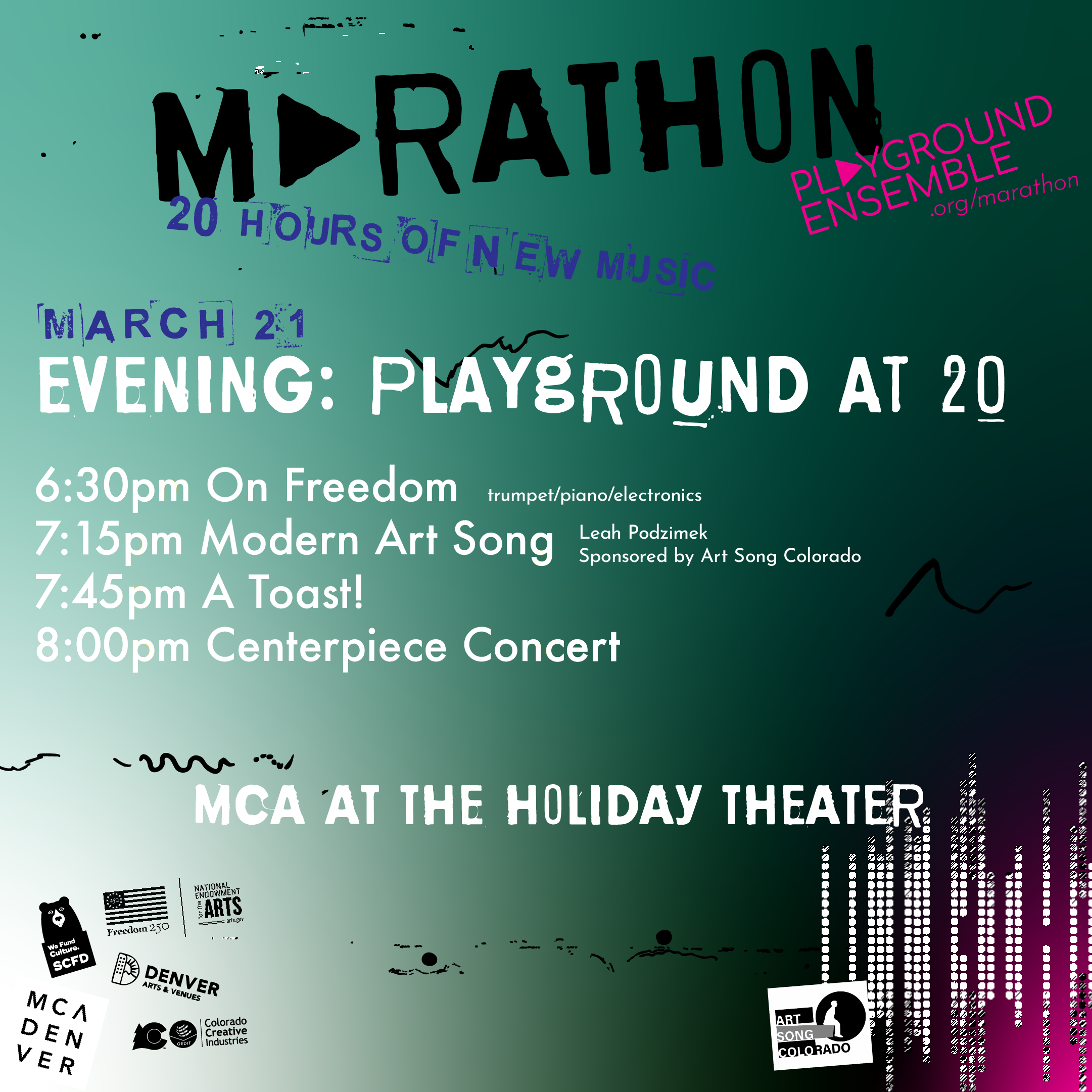
In celebration of our 20th season, The Playground is planning a 20-hour MARATHON! This event will be broken into four blocks, each at a different venue in Denver. MARATHON will be structured to highlight all that we do as an ensemble and organization: concerts, community music-making, sessions for music educators, healing arts events, and an improvised communal cool down in the early hours of Sunday morning.
Modern Art Song
Saturday March 21, 2026, 7:15 PM
MCA Denver at the Holiday Theater
2644 W 32nd Ave, Denver, CO 80211
$20 Tickets
Hosted by MCA Denver at the Holiday Theater, this evening series of concerts is the heart of MARATHON.
When you look through the kaleidoscope of your childhood, what do you see? Do the bright spots of hope, nature, and laughter stand out, or does darkness prevail? Join Leah Podzimek (vocals) and Joshua Sawicki (piano) for a 30-minute program of (mostly) contemporary art songs that recall childhood and gently remind us never to stop playing, even amidst the gloom and doom of life today.
Program
For lyrics to each song, please see here.
“Creation” from Natural Selection by Jake Heggie
Natural Selection is a set of five songs composed in 1997 to poetry by the San Francisco Bay Area writer Gini Savage. The songs trace a young woman’s search for identity, first breaking away from her parents (Creation) to find her way in the world.
Selections from I Hate Music!: A Cycle of Five Kid Songs by Leonard Bernstein
II. “Jupiter Has Seven Moons”
III. “I Hate Music!”
“Leonard Bernstein’s charming song cycle I Hate Music! was dedicated to Edys Merrill, with whom he shared an apartment in New York City in the 1940s. As a young composer, conductor, and soloist, Bernstein often vigorously practiced piano and coached opera singers in the apartment. The incessant musical activity apparently drove Merrill to her breaking point on numerous occasions. She would run about the apartment with her hands over her ears exclaiming, ‘I hate music!’ Amused, Bernstein borrowed it for this unique collection of five brief songs. Each offers a perspective on the world around us through the eyes of a young girls. At times, the underlying maturity of these observations cleverly belies the innocence and inexperience of the narrator. Bernstein gives explicit instructions to the singer at the front of the score: “In the performance of these songs, coyness is to be assiduously avoided. The natural, unforced sweetness of child’s expressions can never be successfully gilded; rather will it come through the music in proportion to the dignity and sophisticated understanding of the singer.
Bernstein wrote the poems used for the text of the cycle, and the songs explore a wide variety of topics and emotions… in the second song (Jupiter Has Seven Moons), Barbara jauntily demonstrates her knowledge of celestial bodies and wonders why Earth has received short srift. The third song serves as the centerpiece and namesake of the cycle. Declaring ‘I Hate music! But I like to sing,’ Barbara shares her plain view of the rarefied world of classical music. It is also regarded as the most popular song of this particular cycle, on account of Barbara Stresiand’s hilariously sardonic rendition.” - The US Marine Band, via Wikipedia; and Abbey Sensenich
“Over the Fence” from Summer. Life. Song. by Adolphus Hailstork
How Graceful Things Are, Falling Apart by Sarah Kirkland Snider
“This song is an attempt to give expression, in some way, to the unfathomable trauma of 9/11. I envisioned a sense of grace in how New York came together to rescue and heal itself, something I experience firsthand living in lower Manhattan when the event occurred. I’ve never experienced the kindness and support of strangers as I did on that day and in the difficult months that followed, and I thought of this as I wrote the music.” - Sarah Kirkland Snider
“Iltarukous” from Four Leino Songs by Kaija Saariaho
“I got acquainted with Anu Komsi in 1987, when she was about 20 years old and recording for the Finnish Radio my trio Adjo, for soprano, flute and guitar. Anu was already a remarkably strong artist, and her characteristic singing style, both intense and natural, was recognizable. We have continued our collaboration on a regular basis since then, which has resulted in numerous joint concerts and recordings.
We moved into a new phase in our collaboration around the year 2000, when Anu commissioned versions of poems by Eino Leino from various Finnish composers. This was the first time I approached a Finnish text since my student years. I had just finished and premiered by first opera L’Amour de loin. While composing the opera, I had spent several years immerged in its French libretto, and I was surprised to realize how different the music that the Finnish language called for was, especially when I later came to orchestrate what developed into a song cycle called Leino Songs.
Eino Leino is one of the most prominent Finnish poets, and every Finn knows his most famous poems from studying them in school. Although I admired Leino, it probably would never have occurred to me to work on his texts, whose rather gradiloquent world was very different from the poems that had until then opened up to me spontaneously as musical material.
But Anu’s invitation was a challenge and therefore interesting, so I composed my first Leino song Iltarukous (Evening Prayer) in 2000. In the following years I spontaneously returned several times to Leino’s texts, always with Anu in mind, and the result was a four-part song cycle.
My vocal writing had changed over the years: my youthful disregard of the ways to make a text sit in the range of a singer’s voice had evolved into a clear - and sometimes even constrictive - awareness of the singer’s instrument’s physical properties. It now felt important to find a natrualness to the way the text is inserted within both the music and the voice.
In the end, Leino’s texts opened up more willingly than I knew to expect, and especially the long vocals allowed for interesting, purely musical encounters between the voice and the piano texture, without breaking the text’s prosody. To me these songs are something like letters to a friend, to whom one wishes to send fresh new at given moments. In that respect these texts too were intertwined into my life.” - Kaija Saariaho, 2021
“A Route to the Sky” from Paper Wings by Jake Heggie
“Paper Wings is the fruit of a great friendship between Heggie and mezzo-soprano Frederica von Stade. She wrote the texts and commissioned Heggie to create the music. Each piece is autobiographical, recalling a specific time in von Stade’s childhood or her daughter’s… The final song [“A Route to the Sky”] describes how von Stade had to be rescued by a fireman after climbing onto her roof as a child and how history repeated itself when [her daughter] Lisa made the same mistake. This song is inspired by Beethoven’s Für Elise -- ‘In this case,’ Heggie states, ‘for Lisa.’” - Julianna Shamel
“My Mother Has Recovered” from Within These Spaces by Lori Laitman
“Within These Spaces sets the poetry of three different Nebraskan women poets - Marjorie Saiser, Janet Coleman and Judith Sornberger. The five poems examine different facets of mother-daughter and grandmother-granddaughter relationships. The title for the cycle, taken from the first poem, works both literally and metaphorically. In the poem itself, the “spaces” are the actual physical spaces once occupied by grandmother and granddaughter. However, in each of these poems, mothers, daughters, and granddaughters also share memories and the experience of passing through similar life-cycle events.
This cycle was commissioned in 2002 by the Nebraska Music Teachers Association for soprano Anne Foradori and pianist Valerie Cisler. As a result of this commission, I was named the 2002 Composer of the Year by the NMTA.
I chose each poem as I went along, adjusting my choices in order to craft a dramatic arc. Each song has a distinct mood…My Mother Has Recovered opens with rhythmic excitement, a commentary on the mother’s energy. The mood alternates between this liveliness and a dreamier waltz as the mother, recovered, and her daughter enjoy their rhubarb and flower-picking experience together.” - Lori Laitman
“Joy Alone (Connection)” from Natural Selection by Jake Heggie
Natural Selection is a set of five songs composed in 1997 to poetry by the San Francisco Bay Area writer Gini Savage. The songs trace a young woman’s search for identity… In Joy Alone (Connection), she at last finds contentment and happiness where it has been all along: within herself. Alone in nature, she revels in a peaceful, beautiful, vibrant connection to the earth.
Goodnight Moon by Eric Whitacre
“Over the first six years of his life, I must have read Goodnight Moon to my son a thousand times, maybe more. Somewhere around reading number 500 I began hearing little musical fragments as I read, and over time those fragments began to blossom into a simple, sweet lullaby. I knew it was a long shot, but I asked my manager, Claire Long, to contact HarperCollins and see if they would allow the text to be set to music. To my surprise and delight they agreed – the first time they had ever allowed Goodnight Moon to be used in such a way. I composed the piece relatively quickly, setting the text for harp, string orchestra, and my son’s mother, soprano Hila Plitmann. I later created a version for soprano and piano, SATB choir and piano and finally, SSA choir and piano.” - Eric Whitacre